
Liquefied natural gas (LNG) is natural gas (predominantly methane, CH₄, with some mixture of ethane C₂H₆) that has been converted to liquid form for ease of storage or transportation. It takes up about 1/600th of the volume of natural gas in the gaseous state. It is odourless, colourless, non-toxic and non-corrosive. Hazards include flammability after vaporization into a gaseous state, freezing and asphyxia.
The liquefaction process involves the removal of certain components, such as dust, acid gases, helium, water, and heavy hydrocarbons. The natural gas is then condensed into a liquid at close to atmospheric pressure by cooling it to approximately −162 °C (−260 °F); maximum transport pressure is set at around 25 kPa (4 psi).
The gas is first extracted and transported to a processing plant where it is purified by removing any condensates, such as water, oil, and mud, as well as other gases, such as CO₂ and H₂S.
An LNG process train will also typically be designed to remove trace amounts of mercury from the gas stream to prevent mercury amalgamating with aluminium in the cryogenic heat exchangers. The gas is then cooled down in stages until it is liquefied. LNG is finally stored in cryogenic tank containers and can be loaded and shipped.
LNG achieves a higher reduction in volume than compressed natural gas (CNG) so that the (volumetric) energy density of LNG is 2.4 times greater than that of CNG. This makes LNG cost-efficient to transport over long distances where pipelines do not exist. Specially designed cryogenic sea vessels (LNG carriers) or Bofort ISO containers are used for its transportation.
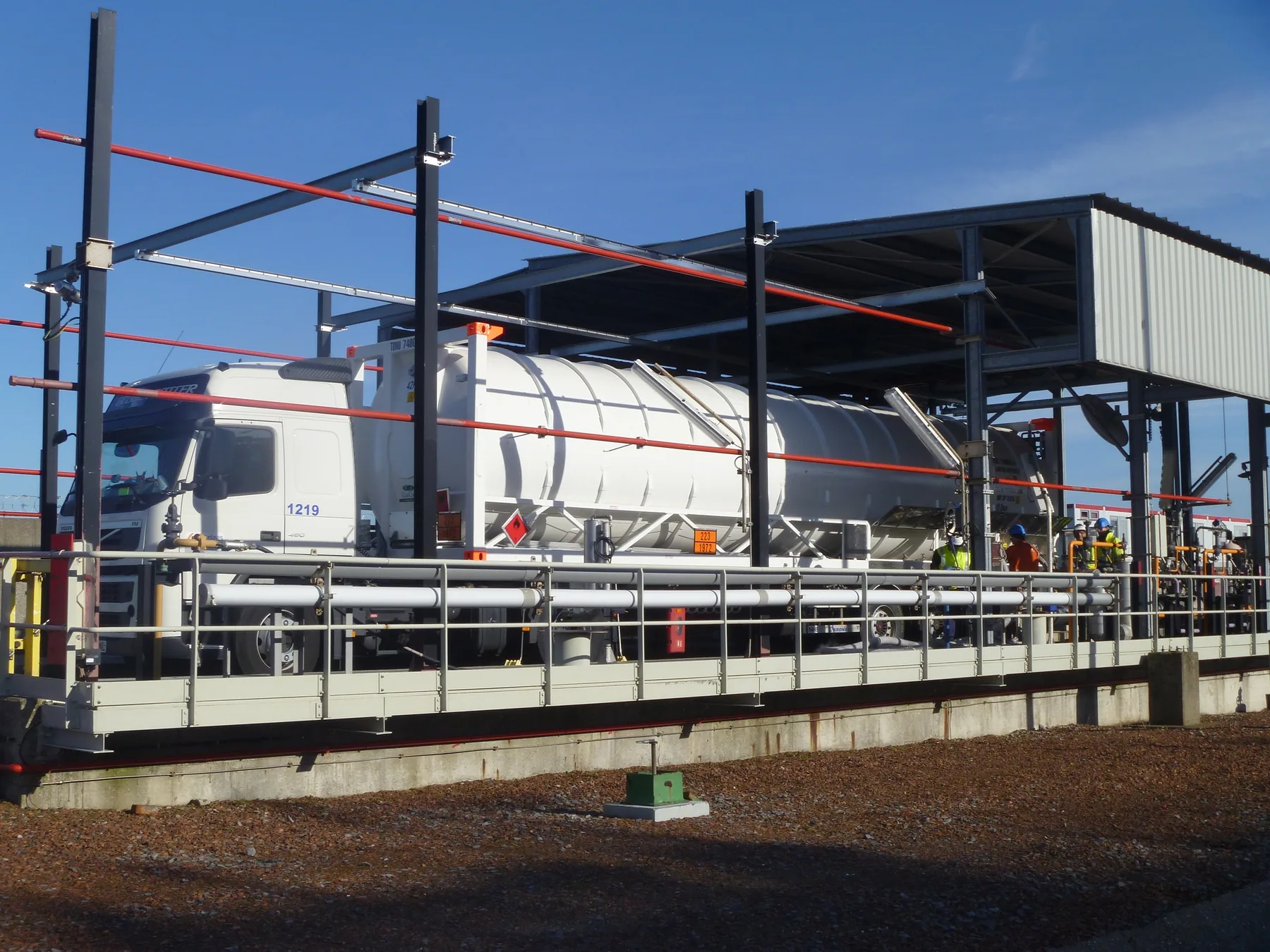
Bofort has substantial expertise in serving the LNG market. Our 40 ft LNG ISO tank containers can be used in many applications for LNG. Learn more about LNG ISO tank capacity and LNG ISO tank specifications. Our tanks have been deployed around the world to provide:
We build to specifications and offer maximum flexibility to our clients. All our equipment is suitable to carry and store gases in their liquid state, such as liquid nitrogen (LIN), liquid oxygen (LOX) and liquid argon (LAR). Whilst recognizing the need to have dedicated equipment for specific trades and products, most of our equipment is also suitable to carry and store carbon dioxide (CO₂), nitrous oxide (N₂O), ethylene, ethane and liquefied natural gas (LNG).
We work with our customers to ensure our tanks can meet the often complex technical requirements of unloading. Ship bunkering or marine refuelling is a rapidly growing application for LNG requiring detailed project management. Our tanks are fitted with pressure build-up units which can be augmented by additional skid-mounted PBUs to meet the challenges of unloading with sufficient differential pressure.
We also have expertise in fitting LNG pumps and metering to our tanks to allow them to be used to fill small-scale LNG facilities. Our tanks also have PED/CE approval allowing them to be used for storage.
We can fit couplings and obtain approvals that allow our tanks to be loaded at major LNG facilities.

Our tanks regularly load at the Fluxys LNG terminal in Zeebrugge (Belgium), the Gate terminal in Rotterdam (the Netherlands) and the Isle of Grain terminal (UK).



We keep a stock of LNG ISO tank containers at designated depots to cater to short-term needs in the market, including LNG ISO tank hire, LNG ISO tank lease and LNG transportation. Rental periods: 1 week to 6 months.
We offer UN1972 LNG ISO tank container rental services under medium and long-term operating lease structures for clients who are looking for operational and financial flexibility.
LNG ISO tank container leasing services are also available via finance. Our tailor-made finance lease structures on selected cryogenic tank equipment can accommodate clients’ specific capital structure needs and requirements.
In addition to its cryogenic tank container rental and leasing services, Bofort advises on and arranges lease structures for specialist cryogenic equipment such as vaporizers and LNG cryogenic pumps.
Bofort offers its services for the management of your LNG gas transport, LNG transport trailers and tank container fleet. We can act as your agent or representative in the acquisition and disposal of your tank containers.
If you need mobile LNG storage or temporary LNG storage contact us to find out more.
